Brand strategy guide

The 12 brand archetypes, and the one your brand should own.

Every brand already has a personality. The question is whether anyone chose it. This is the framework we use to define one, in plain English, with what each archetype looks like for a B2B company.

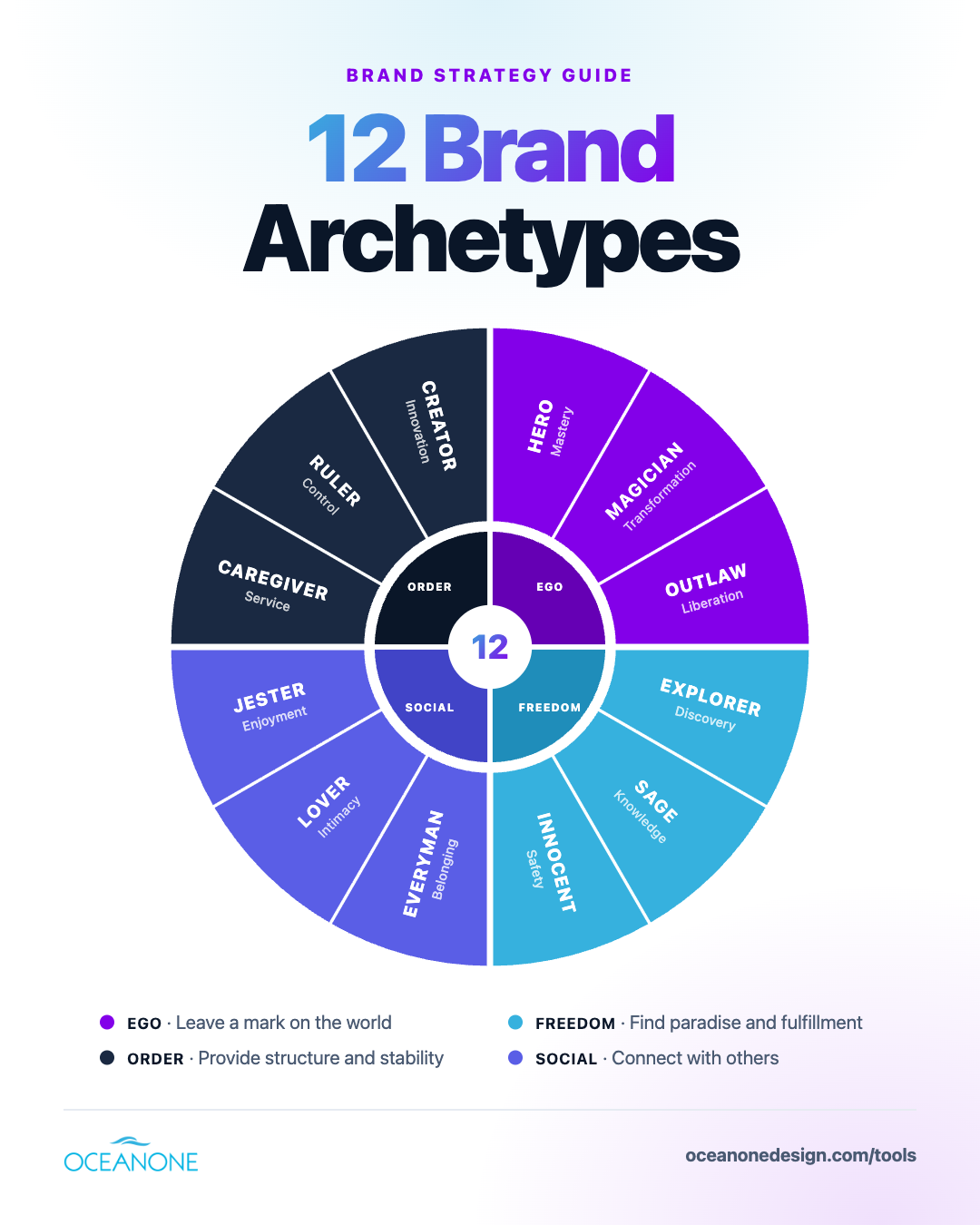
The 12 brand archetypes, grouped by four core drives: Ego (Hero, Magician, Outlaw), Freedom (Explorer, Sage, Innocent), Social (Everyman, Lover, Jester) and Order (Caregiver, Ruler, Creator). HEROMastery MAGICIANTransformation OUTLAWLiberation EXPLORERDiscovery SAGEKnowledge INNOCENTSafety EVERYMANBelonging LOVERIntimacy JESTEREnjoyment CAREGIVERService RULERControl CREATORInnovation EGO FREEDOM SOCIAL ORDER 12

Select any slice to jump to that archetype.

What is a brand archetype?

A character your buyers already recognize.

Psychologist Carl Jung noticed the same characters showing up in stories across every culture: the hero, the wise guide, the rebel, the caregiver. He called them archetypes. In 2001, Margaret Mark and Carol Pearson applied twelve of them to brands in The Hero and the Outlaw, and the framework has been used to define brand personality ever since.

The idea is simple. People don't bond with a list of capabilities. They bond with a character they understand. Choose an archetype and you get a shortcut for every decision that follows: the words you use, the photography you pick, the colors, the jokes you'd make, and the things you'd never say.

The twelve sit around a wheel, grouped by the four basic drives that move people: the need to leave a mark (Ego), to find fulfillment (Freedom), to connect (Social), and to create stability (Order).

Why it matters in B2B

Your buyers are still people.

A marketing director, a purchasing manager or a specifier still picks the supplier they trust. Character builds trust faster than a spec table, and it's what they remember when the shortlist gets made.

Most categories sound the same.

When every competitor promises quality, service and innovation, personality is what's left to tell you apart. An archetype gives you a position that isn't just a feature list.

It keeps everyone on one voice.

Sales, customer service, your agency and the trade show booth all make brand decisions. One archetype gives them the same reference point, with no 60-page manual required.

The four drives

Start with what your brand is driven to do.

Each quarter of the wheel holds three archetypes that share one core motivation. Picking the right quarter narrows twelve choices to three.

EGO

Leave a mark on the world

Brands that win by changing outcomes: higher performance, real transformation, or breaking a category's bad habits.

FREEDOM

Find fulfillment

Brands that win by guiding: making things simple, opening new territory, or knowing more than anyone else.

SOCIAL

Connect with others

Brands that win on relationships and on how it feels to buy from them: belonging, desire, or fun.

ORDER

Provide structure

Brands that win by being reliable, well made, or the standard everyone else is measured against.

The 12 archetypes

What each one wants, fears and sounds like.

Plus what it looks like when a B2B company wears it well, and the trap it tends to fall into.

Ego

Leave a mark on the world
01

The Hero

"Where there's a will, there's a way."
Common in B2B

Courage, performance and winning against the odds. The Hero proves its worth by doing the hard thing better than anyone, and it makes its customers feel capable of doing the same.

WantsTo prove its worth through mastery
FearsWeakness, losing, looking soft
VoiceConfident, direct, motivating
In B2BPerformance under pressure. Equipment rated for the toughest job sites, materials that outlast the warranty, a service team that shows up at 3 a.m.

Watch out: every competitor already says "toughest." A Hero without hard proof sounds like bragging.

Often cited: Nike, FedEx
02

The Magician

"Make it happen."

Transformation. The Magician turns a problem into something the customer didn't think was possible, and makes the change feel almost effortless.

WantsTo make big visions real
FearsUnintended consequences, falling flat
VoiceVisionary, assured, a little mysterious
In B2BTechnology that changes how the customer works: automation that halves a line changeover, a new material that removes a whole process step.

Watch out: vague promises of "magic." Show the before and after, or nobody believes the trick.

Often cited: Disney, Dyson

03

The Outlaw

"Rules are made to be broken."

Also called the Rebel. The Outlaw calls out what's broken in a category and refuses to play along. It attracts customers who are fed up with the status quo.

WantsTo overturn what isn't working
FearsBeing powerless or irrelevant
VoiceProvocative, blunt, irreverent
In B2BThe challenger brand. Publishes prices when nobody else does, ships in days when the category quotes weeks, and says so out loud.

Watch out: cautious buyers in regulated or high-risk categories can read rebellion as risk.

Often cited: Harley-Davidson, Diesel

Freedom

Find fulfillment
04

The Explorer

"There's always more to find."

Discovery, independence and new territory. The Explorer is for customers who want to go further, try the new thing first and never feel boxed in.

WantsFreedom to discover
FearsBeing trapped, conformity, emptiness
VoiceAdventurous, curious, frank
In B2BProducts built for extreme or remote conditions, companies opening new markets, and R&D teams pioneering materials nobody else has tried.

Watch out: restlessness. Chasing every new idea can look like a brand that never commits.

Often cited: The North Face, Jeep

05

The Sage

"Show me the evidence."
Common in B2B

Knowledge, truth and expertise. The Sage helps customers understand the world and make smarter decisions, and it earns trust by being right.

WantsTruth and understanding
FearsBeing misled, ignorance
VoiceKnowledgeable, measured, evidence-led
In B2BThe technical authority. Published test data, specification guides, white papers, and the engineer who can answer any question on the first call.

Watch out: lecturing. A Sage that buries the buyer in data comes across as cold and dull.

Often cited: Google, The Economist

06

The Innocent

"Keep it simple. Do it right."

Optimism, honesty and simplicity. The Innocent promises a world without complications, and customers trust it because it has nothing to hide.

WantsTo be happy and do things right
FearsDoing wrong, being punished
VoiceOptimistic, simple, honest
In B2BThe supplier that makes it easy: clean product lines, clear pricing, natural or food-safe ingredients, no surprises on the invoice.

Watch out: it can read as naive or bland in complex, technical sales.

Often cited: Coca-Cola, Dove

Social

Connect with others
07

The Everyman

"One of us."
Common in B2B

Belonging, honesty and common sense. The Everyman is the dependable, down-to-earth choice that never talks down to anyone.

WantsTo belong and connect
FearsBeing left out or standing out
VoiceFriendly, plain-spoken, practical
In B2BThe fairly priced, reliable partner for the trades and distributors. "We speak your language and we answer the phone."

Watch out: it's the default for brands that never chose. Unintentional Everyman brands are invisible.

Often cited: IKEA, The Home Depot

08

The Lover

"Make it beautiful."

Passion, beauty and sensory pleasure. The Lover makes customers feel desired and special, and the experience of buying matters as much as the product.

WantsIntimacy and experience
FearsBeing unwanted or ordinary
VoiceWarm, sensual, refined
In B2BDesign-led products where look and feel close the sale: premium finishes, textiles, flooring, specialty food. The sample box is half the pitch.

Watch out: style over substance. Back the beauty with performance data.

Often cited: Chanel, Godiva

09

The Jester

"If it's not fun, why do it?"

Humor, play and living in the moment. The Jester gets attention by being the one brand that doesn't take itself too seriously.

WantsTo enjoy the moment
FearsBeing boring
VoicePlayful, witty, irreverent
In B2BRare as a primary archetype, which is exactly why it stands out. It works for trade show stunts, social content and categories drowning in seriousness.

Watch out: jokes undermine trust on big, risky purchases. Use it as a secondary note.

Often cited: M&M's, Old Spice

Order

Provide structure
10

The Caregiver

"We've got you."
Common in B2B

Protection, service and generosity. The Caregiver puts the customer's wellbeing first and makes them feel safe and looked after.

WantsTo protect and care for others
FearsSelfishness, letting people down
VoiceWarm, reassuring, supportive
In B2BSafety products, healthcare supply and service-heavy brands. Training, support lines and account managers who know your name.

Watch out: overpromising service you can't staff. One broken promise costs this archetype more than any other.

Often cited: Johnson & Johnson, Volvo

11

The Ruler

"Set the standard."
Common in B2B

Leadership, control and stability. The Ruler is the category leader everyone else is measured against, and customers buy it because it's the safe, premium choice.

WantsControl, order, leadership
FearsChaos, being overthrown
VoiceCommanding, polished, assured
In B2BThe spec everyone else is compared to. Market leaders, premium brands, and "nobody ever got fired for choosing us."

Watch out: arrogance and distance. Rulers that stop listening get overthrown by Outlaws.

Often cited: Rolex, Mercedes-Benz

12

The Creator

"If you can imagine it, we can build it."

Innovation, craft and self-expression. The Creator makes things of lasting value, and gives its customers the tools to make something of their own.

WantsTo create something enduring
FearsMediocrity, a lack of vision
VoiceInspired, expressive, detail-obsessed
In B2BDesign-forward manufacturers, custom fabrication and R&D-led companies. "Bring us the drawing, we'll build it."

Watch out: perfectionism and self-indulgence. The work has to serve the customer's project, not the portfolio.

Often cited: LEGO, Adobe

Choosing yours

How to pick the right archetype.

The right archetype isn't the one you like best. It's the one that's true, that your buyer needs, and that nobody in your category already owns.

1

Start with what's already true.

Look at why your best customers stay and what they say about you unprompted. An archetype you can't back up with how you actually behave is a costume, and buyers can tell.

2

Decide what your buyer needs to feel.

A plant manager buying safety gear needs reassurance (Caregiver). A designer specifying finishes needs to be inspired (Creator or Lover). An engineer needs proof (Sage).

3

Map your competitors.

If three competitors are Heroes all claiming "toughest," a fourth Hero disappears. The open slot on the wheel is usually the better slot. Our Brand Analyzer maps this side by side.

4

Pick one, plus one.

Choose a primary archetype that leads everything, and at most a secondary that adds depth. A Sage with a streak of Caregiver works. Three archetypes is a committee, not a personality.

Putting it to work

An archetype only counts if people can see it.

Choosing is the easy part. It has to show up the same way everywhere a buyer meets you.

Visual identity

Color, type, photography and layout should all say the same thing. A Ruler looks composed and premium; an Explorer looks like it's been outdoors.

Voice

Write three voice traits with do's and don'ts, then rewrite your homepage against them. If a line would work for a competitor, it isn't in your voice yet.

Content and campaigns

Let the archetype choose your stories. A Sage publishes test data and guides; a Caregiver tells customer rescue stories; a Hero shows the toughest job.

Your team

Sales and service deliver the brand more often than marketing does. Brief them in one page: who we are, how we sound, and what we never do.

How you'll know it's working: prospects describe you in the words you chose, unaided recall goes up at trade shows, and the right buyers start finding you first.

Infographic: the 12 brand archetypes wheel in OCEANONE colors
Free infographic

Keep the wheel handy.

Download the 12 brand archetypes infographic for your next brand workshop, strategy deck or team briefing. It's sized for LinkedIn and Instagram, so feel free to share it with credit.

Download the PNG →
Free tool

Which archetype is your brand sending today?

The Brand Analyzer reads your website, names the archetype you're expressing now and the one you should own, compares you to your competitors, and builds a priced roadmap to get there. It takes about 90 seconds.

Analyze my brand →